Private day trip
Normandy D-Day Beaches Tour from Paris – Private Driver
- 13h
- 250 km
- 1-8 passengers
From1430 €
- Duration
- 13h
- From Paris
- 250 km
- Passengers
- 1-8
- From
- 1430 €
Discover the D-Day Beaches from Paris
At dawn on 6 June 1944, Allied forces landed on five beaches of the Normandy coast, code-named Utah, Omaha, Gold, Juno and Sword. More than 150,000 American, British and Canadian soldiers, along with troops from many other nations, took part in that day, the largest amphibious operation in history.
D-Day opened a new front in Western Europe and marked the start of the Battle of Normandy, followed by the liberation of France. Today, the beaches, cliffs, remains and military cemeteries are places of remembrance, visited every year by families, history enthusiasts and travellers from all over the world.
The main American sites are about 285 km from Paris, a little over three hours' drive each way. With a private driver you go straight to the coast, with no trains or connections, and move from one site to the next at your own pace.
Omaha Beach: An Iconic D-Day Beach
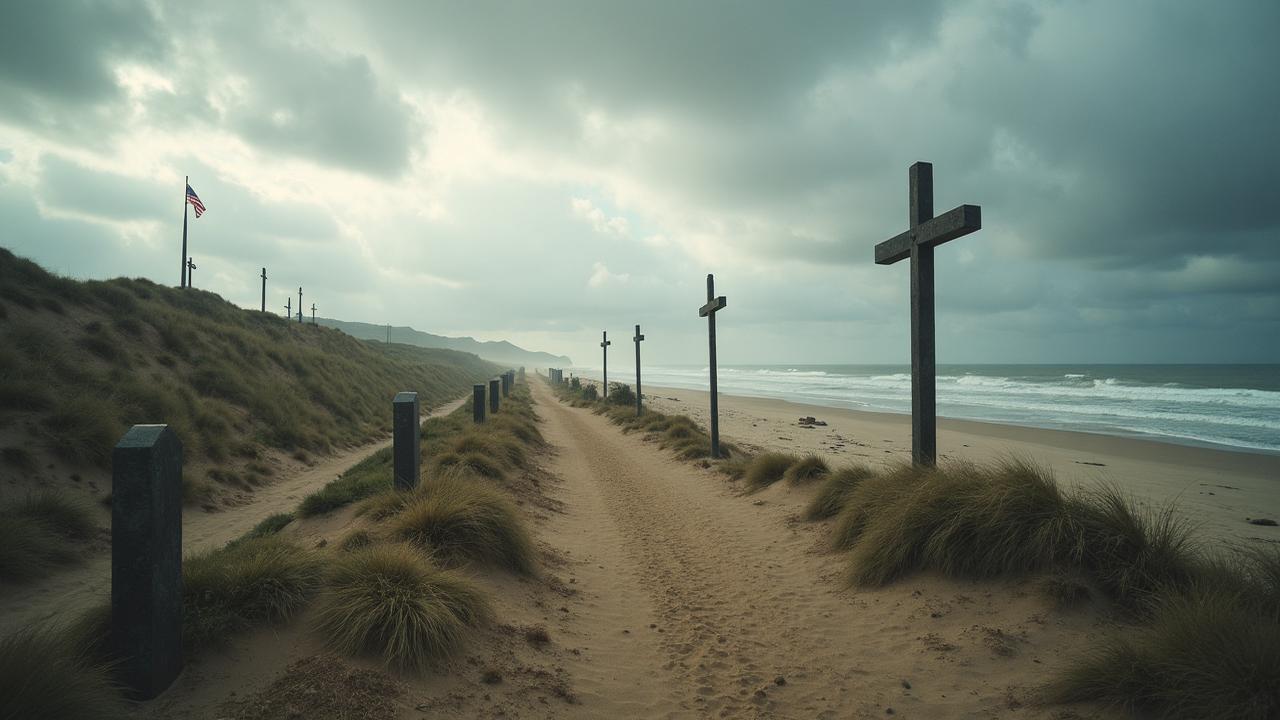
Omaha Beach stretches for about 8 km, from Vierville-sur-Mer to Colleville-sur-Mer and Sainte-Honorine-des-Pertes, below bluffs that were heavily defended at the time. On 6 June 1944, soldiers of the US 1st and 29th Infantry Divisions suffered the heaviest losses of all the D-Day beaches here.
Today, the long sandy beach is freely accessible. At Saint-Laurent-sur-Mer, the sculpture "Les Braves", installed in 2004 for the 60th anniversary, and several memorials recall the soldiers' sacrifice. At low tide, the width of the shore shows the distance the men had to cross in the open.
Normandy American Cemetery at Colleville-sur-Mer
On the bluff overlooking Omaha Beach, the Normandy American Cemetery holds the graves of almost 9,400 American service members, most of whom died in the D-Day landings and the fighting that followed. The Walls of the Missing bear almost 1,600 names. The site is cared for by the American Battle Monuments Commission (ABMC), a US federal agency.
The rows of white marble Latin crosses and Stars of David, the memorial with its statue "The Spirit of American Youth Rising from the Waves", and the visitor centre with its personal stories invite quiet reflection. Every day, a flag-lowering ceremony takes place one hour before closing.
ABMC reminds visitors that its cemeteries are sacred burial grounds: calm and respectful behaviour, appropriate dress and photographs worthy of the place are expected. The path that led down from the cemetery to the beach has been closed to the public since 2016.
Pointe du Hoc: A Remarkable Historic Site
Between Omaha Beach and Utah Beach, Pointe du Hoc is a headland whose cliffs rise about thirty metres above the sea. The Germans had installed an artillery battery there that could fire on both beaches. On 6 June 1944, the Rangers of the 2nd Battalion, led by Lt. Col. James E. Rudder, scaled the cliffs with ropes and ladders to put the guns out of action.
The site remains close to how it looked in 1944: bomb craters, shattered casemates and bunkers form a striking landscape. A granite monument, set on top of a former bunker, honours the Rangers. Pointe du Hoc, also managed by ABMC, is a possible stop during the day, depending on opening hours, traffic, access conditions and the time available: restoration work is under way there until mid-2027.
The D-Day beaches in pictures
Private Normandy Day Trip with a Driver
Your driver picks you up at your hotel or Paris address at the time you choose, in a premium vehicle with water and Wi-Fi on board. You travel to the Normandy coast in comfort, and your driver takes you back to Paris at the end of the day.
On site, your driver handles the journeys between sites, drops you off and picks you up at car parks and authorised locations, and helps you organise the day around opening hours and the time remaining. You choose the stops (beaches, memorials, possibly a museum) within the 13 hours booked.
Your driver is not a professional tour guide. If you would like historical commentary, you can book a local guide or a museum separately, or join the talks offered on site by ABMC, depending on the season.
Indicative 13-Hour Itinerary
A typical outline with Omaha Beach and the American Cemetery, to be adapted to your wishes and to the sites' opening hours:
Departure
Early pick-up at your hotel or Paris address.
About 3.5 hours' drive
Drive to Omaha Beach (about 285 km), depending on traffic and any diversions.
Omaha Beach, about 1 hour
The beach, the "Les Braves" sculpture and the memorials.
American Cemetery, about 1.5 hours
About 10 minutes from Omaha Beach: self-guided visit of the cemetery, the memorial and the visitor centre.
Lunch at leisure
Lunch break of about 1 hour nearby, at your own expense.
Pointe du Hoc, about 1 hour (possible stop)
About 15 minutes from Omaha Beach, depending on opening hours, access conditions during the works and the time available.
Return, about 3.5 to 4 hours
Drive back to Paris (about 290 km), depending on traffic.
Arrival
Return to your Paris address, about 13 hours after pick-up.
Times and durations are indicative and depend on traffic, crowds and site access conditions. Omaha Beach and the American Cemetery are the main stops; Pointe du Hoc remains a possible stop, without guarantee. Driving takes up about half the day: fully visiting several museums is not realistic, but a museum can replace one of the stops.
Practical Information and Official D-Day Sites
Allow about 285 km and 3 hours 15 minutes to 3 hours 45 minutes' drive from Paris to Omaha Beach, depending on traffic, and the same for the return. ABMC reports that part of the A13 motorway between Paris and Normandy is closed from 16 November 2026 to August 2027: diversions may lengthen the journey. On site, the American Cemetery is about 10 minutes from Omaha Beach, and Pointe du Hoc about 15 minutes.
Visits are made on foot and outdoors. The American Cemetery is wheelchair accessible, but its paths are long. At Pointe du Hoc, the ground is uneven, with deep craters: stay on the marked paths; the site is not wheelchair accessible during the works. On the coast, wind, rain and changing weather are common, even in summer: bring warm, waterproof clothing and good shoes.
Every 6 June, ABMC holds a ceremony at the American Cemetery. In 2026, the cemetery stayed open, but the ceremony was for invited guests only, the car park was closed to the public until early afternoon and the visitor centre was closed for part of the day. Around that date, the coast is very busy and traffic restrictions apply: allow plenty of extra time or choose another date.
These sites are places of remembrance. ABMC asks for calm, respectful behaviour and photographs worthy of the place; flying a drone requires a permit. The information below was checked on the official websites in November 2026 and may change, so check it before choosing your date. Paris Global Mobility cannot guarantee opening hours or access conditions.
Normandy American Cemetery (ABMC) (opens in a new tab)
Open every day from 9 am to 5 pm, last entry 4:30 pm; closed on 25 December and 1 January. Free admission, with no booking required at present. ABMC has announced a free, mandatory pre-registration for visits from summer 2027.
Pointe du Hoc Ranger Monument (ABMC) (opens in a new tab)
Open every day from 9 am to 5 pm; according to the official visit page, closed from 12:30 to 1:30 pm between 1 October and 31 March. Free admission, no booking required. Restoration work until mid-2027: visitor centre closed since 9 March 2026, some paths and bunkers closed since mid-May 2026, access to the historic site via the west path only, limited parking.
Omaha Beach — Bayeux Bessin Tourist Office (opens in a new tab)
The beach and its memorials are freely accessible all year round. The intercommunal tourist office presents the nearby D-Day sites and museums. Museums charge admission, have their own opening hours and remain optional visits, to be booked and paid for directly.
Paris Global Mobility provides private transportation with a driver. Guided tours, museum admission tickets and meals are not included in the transport price.
Included in price
- Private vehicle with driver
- Round-trip transport from Paris
- Transfers between the planned stops
- Vehicle and driver at your disposal for the 13 hours booked
- Drop-off and pick-up at authorised locations
- Mineral water on board
- Free Wi-Fi on board
Not included
- Paid museum admissions
- Guided tours and professional tour guides
- Lunch
- Personal purchases
- Additional tourist services not selected
Paris Global Mobility provides private transportation with a driver. Guided tours, museum admission tickets and meals are not included in the transport price.
Practical tips
- Leave early: the American Cemetery closes at 5 pm, last entry at 4:30 pm
- Appropriate dress and a respectful attitude at the cemetery, a burial ground
- Bring warm, waterproof clothing: the wind can be strong on the coast
- Walking shoes recommended: sand, uneven paths and craters at Pointe du Hoc
- Around 6 June, expect large crowds and restricted access: allow extra time or choose another date
D-Day beaches day trip: frequently asked questions
How long does the D-Day beaches day trip from Paris last?
- The trip lasts 13 hours, from pick-up in Paris to your return. Allow about 3.5 hours' drive each way, sometimes more depending on traffic and roadworks on the A13 motorway. That usually leaves 5 to 6 hours on site, including a lunch break.
Which historic sites can you see during the day?
- The typical programme includes Omaha Beach and the American Cemetery at Colleville-sur-Mer, the two main stops. Pointe du Hoc can be added depending on opening hours, traffic, access conditions and the time available. Another site, such as a D-Day museum, can replace a stop, but fully visiting several museums is not realistic in one day.
Is the Normandy American Cemetery open to the public?
- Yes. According to ABMC, the cemetery is open every day from 9 am to 5 pm (last entry 4:30 pm), except on 25 December and 1 January. Admission is free and does not currently require booking; however, ABMC has announced a free, mandatory pre-registration for visits from summer 2027. Check the conditions on its official website before your visit.
Are museum tickets included in the price?
- No. Paris Global Mobility provides private transportation with a driver. Guided tours, museum admission tickets and meals are not included in the transport price. The American Cemetery, Pointe du Hoc and the beaches are free to visit.
Can you visit Omaha Beach and Pointe du Hoc on the same day?
- Yes, the two sites are only about fifteen minutes apart. Pointe du Hoc is open every day from 9 am to 5 pm; according to the official visit page, it closes from 12:30 to 1:30 pm between 1 October and 31 March. Until mid-2027, restoration work closes part of the site, some bunkers and the visitor centre, and limits parking, so the visit may be shorter.
Can you book a private van for a group trip to Normandy?
- Yes. A van carries up to 8 passengers, a sedan or a First vehicle up to 3. For a larger group, the booking form automatically offers several vehicles, up to 4.
Book this excursion
From 1430 €
Paris Global Mobility provides private transportation with a driver. Guided tours, museum admission tickets and meals are not included in the transport price.
Estimated return time around 22:00
- Private round-trip transport
- Driver waiting time included
- Premium services included
Secure payment





Total price1430 €